
Tooted
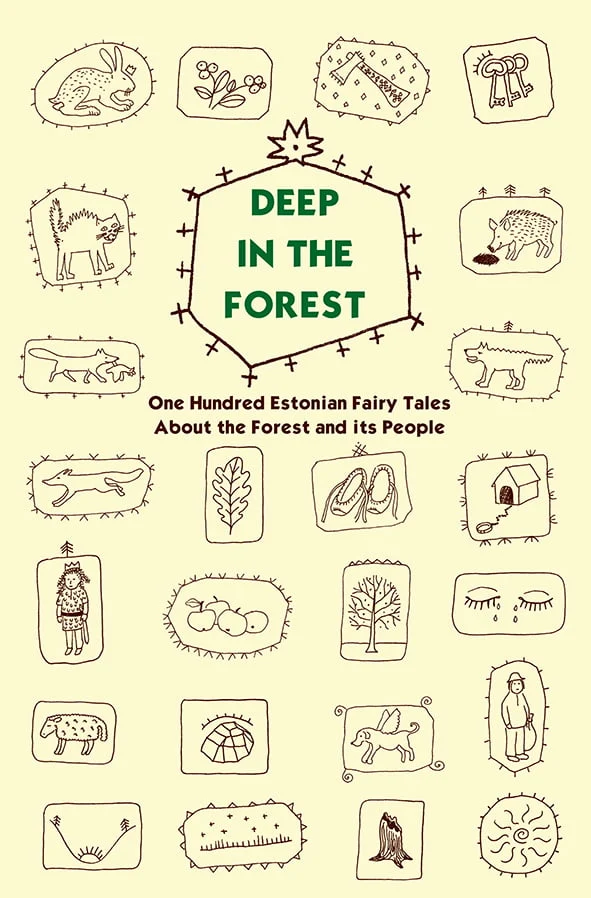
Perched on the northern rim of the Baltic States, one thing for which Estonia is known far and wide is its folklore collections, which are among some of the largest in the world. Another aspect that makes the country exceptional is that, in spite of urbanisation, modern Estonians are still enthralled by their forest, and half of the territory is wooded. Forests and fairy tales stand side by side in this book. Here, you will find stories about the forest and the humans, animals, and supernatural creatures that thread its paths. Fairy tales reveal what people hold dear, the observations they make, and what lies at the depths of their souls. Thus, the English-language title: Deep in the Forest. Compiled by Risto Järv and translated into English by Adam Cullen, each fairy tale in this collection can also be found in the Estonian Folklore Archives.
Muinasjutud räägivad sellest, mida inimesed peavad oma elus oluliseks, mis on neil hingel. Muinasjutt jutustab alati ennekõike jutustajaist endist. Eesti inimesele on mets oluline paik, seepärast viib ka hulk meie muinasjutte metsa. Folklorist Risto Järv on Eesti Rahvaluule Arhiivi 15 000 muinasjutust välja otsinud sada metsaga seotud lugu ning need tänapäeva lugejale ümber jutustanud. Raamatus on muinasjutte metsast, metsas käivatest inimestest, seal elutsevatest loomadest ja kohatud üleloomulikest olenditest. 2016. aastal ilmus eesti keeles metsamuinasjuttude kogumik „Metsavaimu heategu. Sada eesti muinasjuttu metsast ja meist“. Eesti Vabariigi 100. sünnipäeva auks on tõlkija Adam Cullen pannud raamatu ümber inglise keelde.
Kordustrükk.
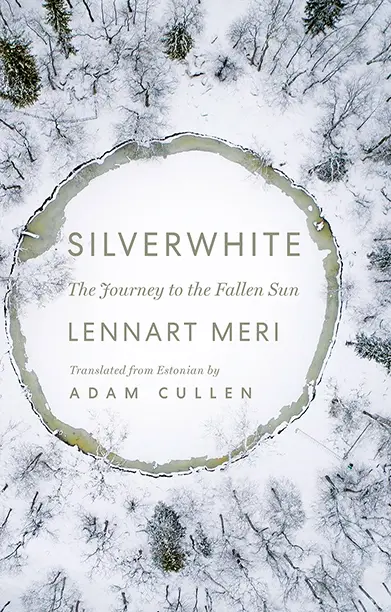
Silverwhite is a captivating exploration of the eastern Baltic nations' earliest history and interactions with Mediterranean and Near East peoples. This journey meticulously outlines an answer to the true whereabouts of Thule, the unearthly northernmost land of ancient legend. Although Silverwhite is grounded in classical literature and extensive historical, astronomical and geographical fact, Lennart Meri–foremost a writer and filmmaker–weaves his travelogue with poeticism.
Whereas a professional historian must show caution when using fantasy to patch gaps between facts, a poet is untethered. This epic work can also be read as a thriller: millennia ago, an enormous cosmic rock crashed into the Estonian island of Saaremaa. Through this extraordinary historical event, Meri brings together a curious cast including ancient Greeks, Arabs and Estonians.
All genuinely existed and met, even if their names have been lost to oblivion. When Meri wrote Silverwhite, Estonia was occupied; forced into the restrictions of Soviet Russian colonialism. His work was a balm against that closed-minded and unnatural state, offering the unmistakable message that the world has never been divided into isolated islands of civilisation.
Nations, eternally interconnected, have always shared knowledge and impacted one another in complex ways. Openness is inherent.
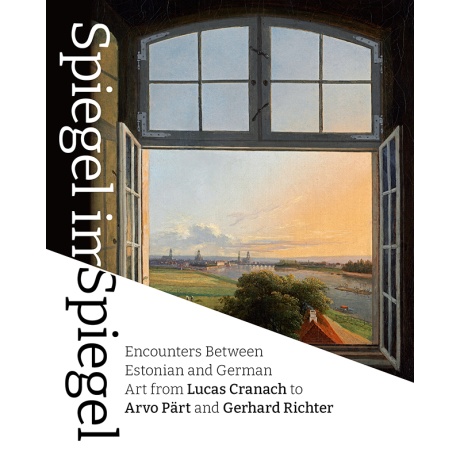
The book accompanies the exhibition Spiegel im Spiegel: Encounters Between Estonian and German Art from Lucas Cranach to Arvo Pärt and Gerhard Richter at the Kunsthalle im Lipsiusbau, Dresden (8 May – 31 August 2025), and at the Kumu Art Museum, Tallinn (24 October 2025 – 12 April 2026).
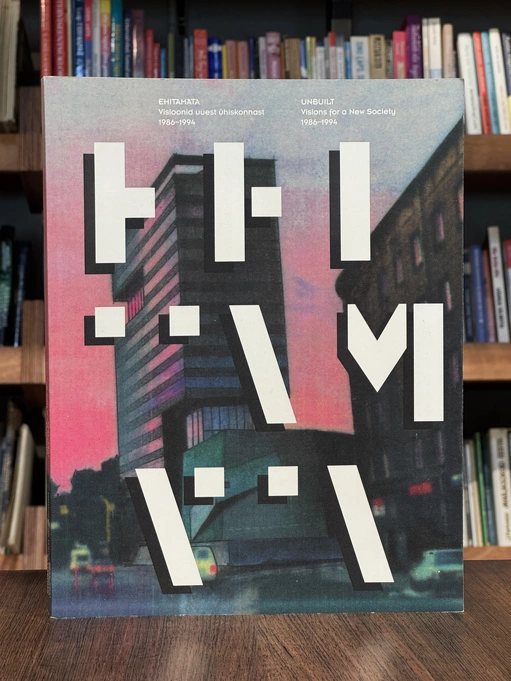
The Art Museum of Estonia and the Dresden State Art Collections (Staatliche Kunstsammlungen Dresden) present an ambitious collaborative exhibition exploring the intersections of Estonian and German/Saxon art in history. Visitors are invited on an odyssey, framed by a dialogue between two great figures, the German painter Gerhard Richter and the Estonian composer Arvo Pärt. The journey is enriched with insights into the history of the medieval Hanseatic League, Dresden Romantics and the Baltic German community, 20th-century art and a number of contemporary interventions.
The book gives an overview of twelve carefully selected dialogic themes in the exhibition that throw light on Germans and Estonians’ self-understandings, while paintings, graphic works, objects, videos and installations mirror, and are mirrored in, each another.
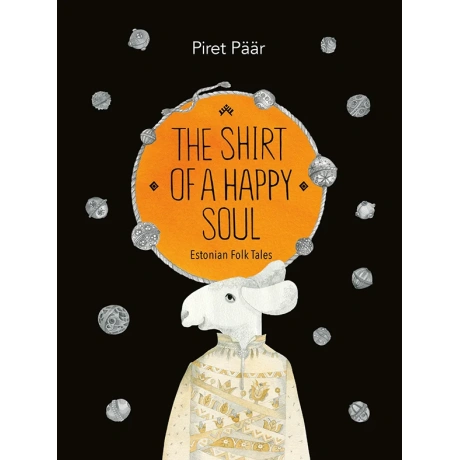
In these pages, you will find a little bundle of Estonian folk tales. Some are certainly familiar, others you haven’t yet read or heard.
This is a book for all ages. You will find stories for people big and small, moms and dads, grandparents, teachers, and even… Or rather, each story has something for kids and grown-ups, wives and husbands, beggars and kings, and even…
Piret Päär is a professional storyteller and actress. “Every story that speaks to you is a path to yourself. Without fairy tales, I would’ve been lost in life.”
Katrin Erlich is an illustrator and graphic artist. “I almost never retell the text in my illustrations. Rather, I depict what the characters are thinking and feeling.”
Adam Cullen is a poet and translator of Estonian literature into English. To date, he has translated over a dozen novels, countless poetry, children’s books, and twenty plays. “To me, translation is music and balance—following rhythms and staying faithful to the author and the reader simultaneously.”